Why growing websites become more specialized
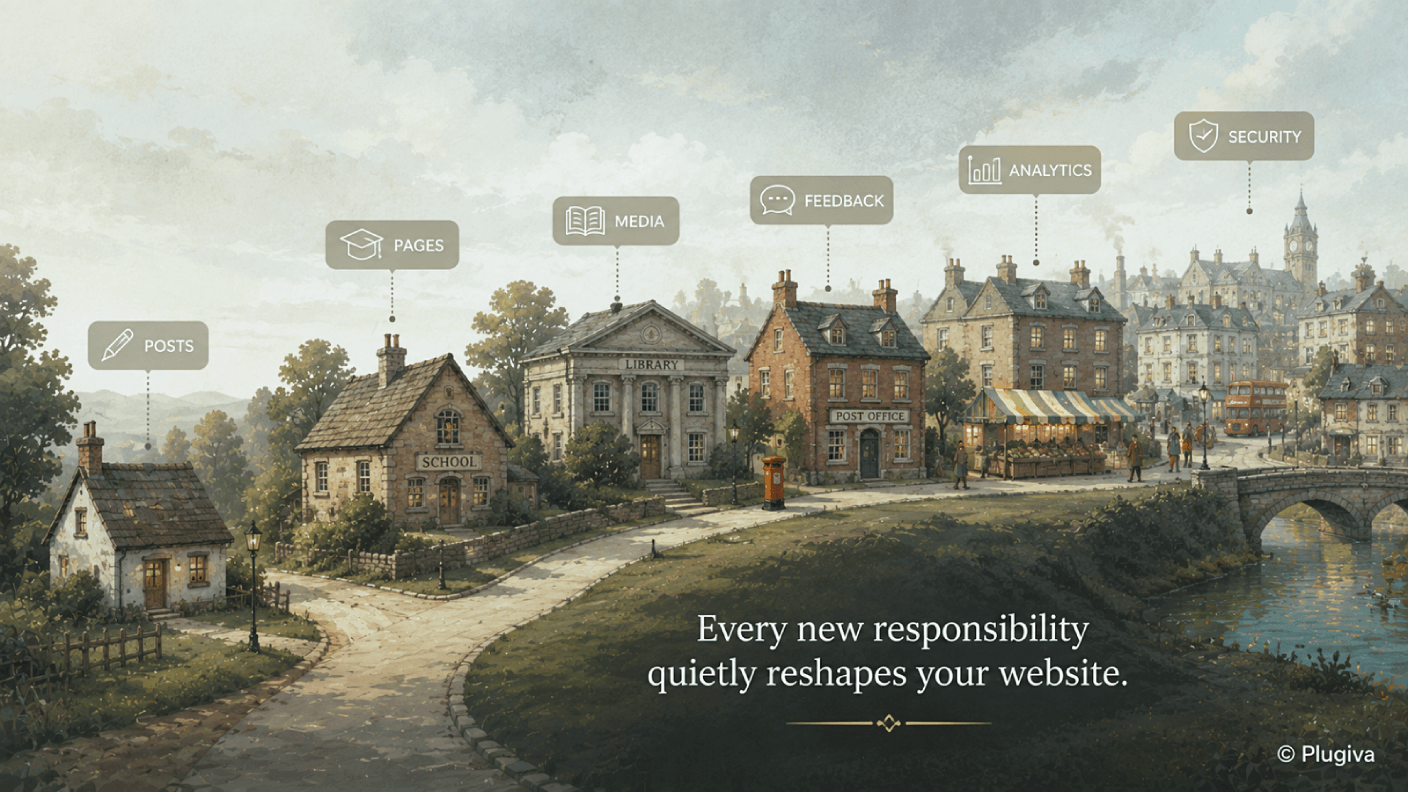
When Plugiva first went online, our content management system was remarkably simple.
Posts. Pages. That was enough.
Looking back, what surprises me isn't how much the website has changed. It's how little of that change was planned.
As we started publishing more regularly, we joined communities like Reddit and Indie Hackers to share our work and learn from other builders. Those conversations gradually exposed needs we hadn't anticipated.
Managing media became more important, so we integrated Cloudinary.
As we spent more time writing, we became curious about how readers were responding. That led us to build our own lightweight reaction system, Plugiva Pulse, so readers could share how an article resonated with them without interrupting the reading experience.
As the website continued to grow, we began thinking about a simple analytics system that could answer questions specific to our own content rather than relying entirely on general-purpose tools.
Even something as ordinary as the contact form changed. As spam slowly became noticeable, improving its protection stopped being optional.
None of these decisions appeared on an original roadmap.
Each one arrived because the website had taken on a new responsibility.
For a long time, I would have described this as the website becoming more complex.
Now I'm not so sure.
Complexity often carries the feeling that something has become harder to understand or manage. That wasn't what was happening.
The website wasn't becoming more complicated for the sake of having more features.
It was becoming more specialised because every new responsibility deserved a better way of working.
The more I think about it, the more I realise this isn't unique to Plugiva.
A university website gradually develops dedicated sections for admissions, academics, research, and alumni. An online store eventually separates merchandising, customer support, inventory, and fulfilment. A software company begins with a simple marketing site before documentation, customer onboarding, feedback systems, and product updates slowly find their own places.
These websites don't become specialised because someone enjoys building larger systems.
They become specialised because the organisations behind them continue to grow into new responsibilities.
Perhaps that's why mature websites rarely feel like a collection of random features.
When they evolve well, every specialised part exists for a reason. It reflects a responsibility that didn't exist, or wasn't important enough, when the website was younger.
Looking back, I don't think growing websites become specialised because they become bigger.
They become specialised because growth quietly changes what is expected of them. And once those specialised responsibilities begin to grow side by side, another question naturally follows.
How do all of those different parts continue working together as one website?
Has your website become more specialized over time?