Software protection has to survive the unexpected path
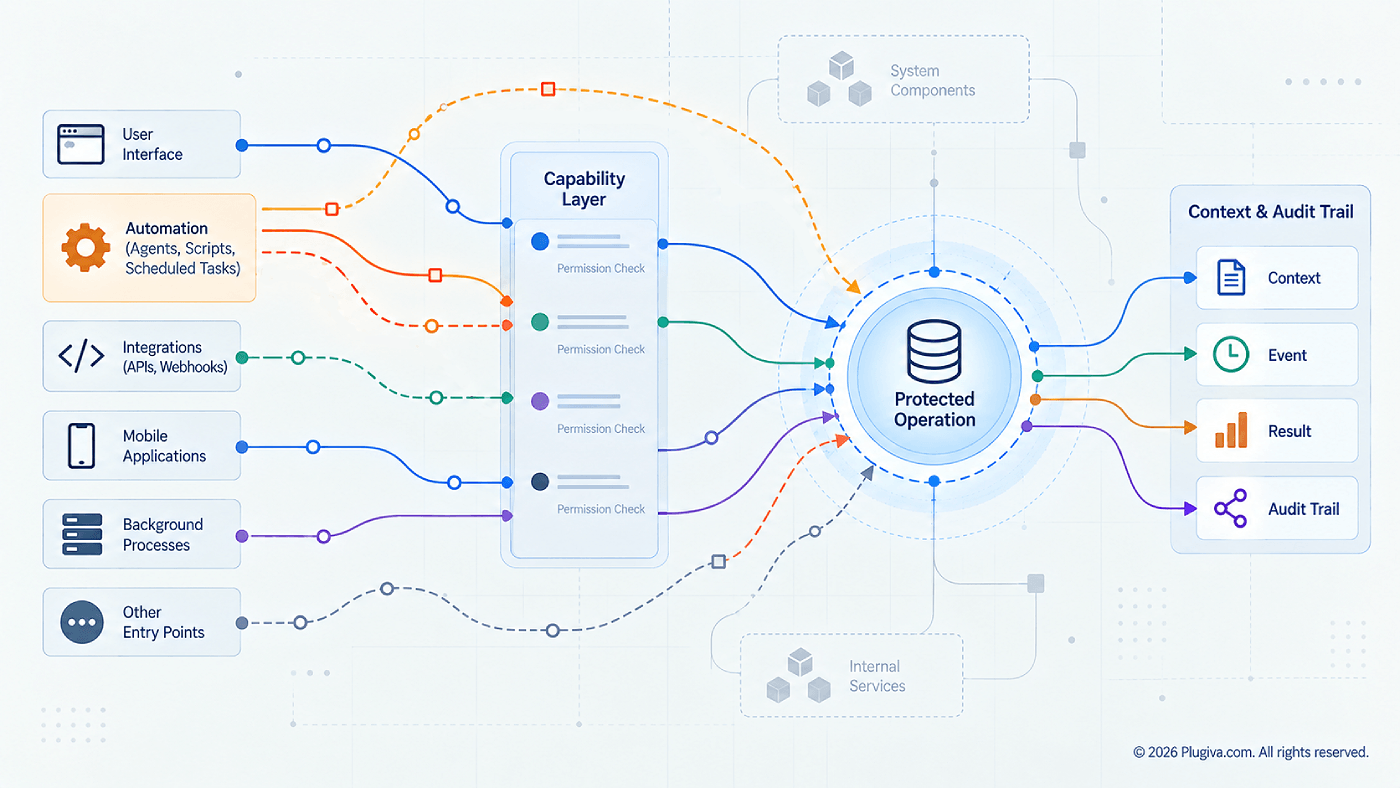
A protection system usually has an expected path for important actions.
An actor reaches an operation through a boundary, the boundary determines whether that actor should be allowed to proceed, and the operation continues when the conditions are satisfied. This is a useful way to keep a system under control without interfering with everything that happens inside it.
For systems that can be extended by different components, that expected path can become an important assumption. The person using the system may know what they want to accomplish without knowing exactly how every component will carry out the work. As long as the operation follows the path the protection understands, that distinction may not matter.
But the path is not always guaranteed.
A component can reach an operation in a different way from the one the protection was designed around. The original permission may still be valid. The protection at that boundary may still be working exactly as intended. Yet the operation can arrive somewhere deeper in the system without depending on that boundary.
This possibility has always existed in software, but it becomes harder to overlook as software takes on more responsibility for carrying out instructions. AI automation makes this especially relevant because software can increasingly interpret an intention, decide how to accomplish it, and perform the resulting operations without exposing its internal path to the person who gave the instruction.
That does not make the expected path unimportant. It changes what we can reasonably assume about it.
If an operation is important enough to protect, its protection may need to remain meaningful even when the path taken to reach that operation is not the one we expected.
That is where the boundary between a permission and a deeper form of protection begins to matter.
When protection follows the expected path
Permission is one of the most practiced ways a system protects an operation.
An actor is given a defined level of access, and the system uses that information when deciding whether an operation should be allowed to continue. This gives protection a clear point at which to make a decision without having to interfere with every action that takes place inside the system.
For a system's normal path, this can work very well. The actor reaches the operation through the expected application flow, the relevant capability is checked, and the operation proceeds only when the conditions are satisfied.
This is not a superficial form of protection. It establishes an important relationship between the actor and the operation. The system knows who is attempting to do something and can determine whether that actor should be allowed to do it.
The boundary becomes more interesting when we consider what it actually knows.
A capability check can establish that an actor is permitted to perform an operation through the path where that check exists. It does not necessarily establish that every route to the same operation will pass through the same decision.
That difference does not make the permission layer inadequate. It simply defines its scope.
When the expected path is also the path the system can reliably control, the boundary provides meaningful protection. The assumption begins to matter when something inside the system can reach the same operation without depending on that path.
When protection has to reach the operation
A permission boundary protects an operation only where the system can rely on that boundary being part of the path.
In an extensible system, that path is not always something the person using the system can see. Different components can have their own ways of reaching functionality that already exists inside the system. They may still operate with legitimate authority, while reaching an operation through mechanisms that are different from the path a person would normally follow.
This does not make those components inherently unsafe. It means that the protection around an important operation cannot depend entirely on knowing how every component will reach it.
The distinction becomes clearer when the thing being protected is a consequence rather than an access decision. If the concern is an unintended change that could leave a running system in an undesirable state, the important question is not only whether the actor was allowed to act. It is also whether the operation that can produce that change remains within the intended protection.
This is where protection has to reach further than the permission boundary.
The permission layer can continue doing its job. It can establish whether an actor has the authority to operate within the system. A deeper protection point can have a different responsibility: ensuring that a specific operation remains protected even when the route used to reach it is different from the one originally expected.
That does not mean every operation needs another layer of protection. The scope has to come from what the system is deliberately trying to protect.
Once that scope is clear, the architecture becomes easier to reason about. Protection is no longer tied only to the question of who may act. It can also be placed around the operation whose consequences matter.
When software chooses the route
Software has always been capable of taking different routes through a system. What is changing is how often software is now being given the responsibility to decide how an instruction should be carried out.
An integration may be given enough authority to operate within a system, while its implementation determines how it reaches the functionality it needs. The person using it may be concerned with the intended result, while the software determines the actions required to produce that result.
This distinction became concrete for us while testing an AI-integrated component in WordPress.
We had already treated the capability layer as the appropriate protection for the normal WordPress path. It remained valid. But during testing, we found that the component could reach the plugin installation mechanism without encountering the individual capability checks we had expected around that operation. It was still operating with higher-level authority, but the specific permission decisions we had associated with the operation were not necessarily part of the route it took.
That changed what we needed to protect.
The question was no longer whether the capability layer was doing its job. It was whether plugin installation itself could remain protected when software reached the underlying operation through a different route.
The answer required protection closer to the operation.
This is where AI automation makes the issue more visible. When software can participate in deciding how an instruction is accomplished, the path it takes can become part of the protection problem.
That does not make the software inherently unsafe. It means the protection cannot reasonably depend on the assumption that software will always reach an important operation through the path we expected.
As software becomes more capable of choosing how to accomplish an instruction, the important question becomes less about controlling every possible route and more about ensuring that the operations we deliberately chose to protect remain protected regardless of which route reaches them.
Protection should know when not to intervene
Protection becomes useful only when its boundaries are deliberate.
If a system is expected to protect a particular operation, that protection needs to know when the operation falls within its scope and when it does not. Otherwise, protection can become either too weak to matter or too restrictive to remain useful.
This distinction matters because the same operation may be approached by people with different levels of authority. An administrator working within an ordinary operational boundary may need the protection to intervene when it is active. Someone with deliberately higher authority may need the ability to override that boundary when the situation requires it.
The important part is that these are different decisions. Protection does not have to determine that every actor should be stopped. It has to determine whether the operation is currently subject to the protection and whether the actor has authority to proceed beyond it.
In ClientGuard, this became particularly relevant as the protection moved closer to the operation itself. Once plugin installation was treated as a protected operational point, the protection could no longer depend on which route had brought the system there. When protection was active, reaching that point was enough for the guard to do its job.
At the same time, the existence of a protection boundary does not remove the need for authority above that boundary. A sufficiently privileged action may deliberately bypass active protection. That does not make the protection meaningless. It defines where the protection yields.
This is where intervention and observation begin to separate. Intervention determines what the protected boundary should allow to happen. Observation preserves the context of what actually happened around that boundary.
A protection system therefore does not need to treat every action in the same way. It needs to know where its responsibility begins, where authority can supersede it, and what should remain visible afterward.
Why preserving context matters for an audit trail
Once protection reaches the operation itself, the operation becomes a useful point of reference.
The route taken to reach it may vary. The actor may have different levels of authority. Protection may intervene, or it may deliberately yield. What remains constant is that the operation reached a point the system had decided was important enough to protect.
That makes what happens around that point worth preserving.
An audit trail is useful when it retains enough context to make an operation understandable afterward. Knowing that an operation occurred is only the beginning. The surrounding information can help establish when it happened, what initiated it, how the protection boundary responded, and what the system encountered at that point.
This became particularly relevant during our testing of AI-integrated software in WordPress. The unexpected route was important because it changed what we understood about where the expected permission decision occurred. Once the protection moved closer to the operation, the event itself became a more reliable reference for understanding what had happened.
The purpose of preserving that context is not to assume that every unexpected operation represents a problem. An operation may have been stopped by protection, deliberately allowed by higher authority, or simply observed within the protected scope. In each case, the context can matter later when someone needs to understand the state of the system at the time.
When the route to an operation can no longer be taken for granted, preserving context around the operation gives the system something more stable to reason about afterward.
Protection can decide what should happen at the boundary. An audit trail can help preserve what happened there.
Protection evolves around where consequences matter most
A system does not need every operation to receive the same depth of protection.
The permission layer can continue to govern ordinary activity, providing a clear relationship between authority and the operations an actor is allowed to perform. Deeper operational protection becomes meaningful when the consequence of getting a particular operation wrong justifies another point of protection.
This changes the question we ask about the system.
Instead of trying to predict every route that software might take, we can ask which operations could leave the system in a state that is costly, disruptive, or difficult to recover from if they produce an unintended result. The cost does not have to be financial. It can be the time required to recover, the effort needed to understand what changed, or the difficulty of returning the system to a useful state.
Once that operation has been identified, the protection point becomes more deliberate. The purpose is not to make every operation harder to perform. It is to recognize where an operation carries enough consequence that deeper protection becomes worthwhile.
This also changes how we think about unexpected routes. A component may reach an operation through the expected application flow, while another may reach the same underlying mechanism differently. The protection does not have to understand every route individually if the operation itself has been deliberately chosen as the point that matters.
That is where protection can evolve without becoming excessive.
The system can retain its normal permission boundaries and continue operating through them. Around the operations whose consequences matter most, protection can move closer to the point of action, intervene when necessary, yield when legitimate authority requires it, and preserve the context needed to understand what happened afterward.
The result is not a system where everything is treated as dangerous. It is a system where protection has been deliberately placed where an unintended consequence would matter.
The conclusion is therefore fairly simple: protection does not have to predict every path software may take. It has to remain meaningful where an operation can produce consequences the system cannot afford to leave entirely to assumption.
That makes deeper protection a matter of deliberate scope. The permission layer can continue to govern ordinary activity, while selected operations receive protection that reaches closer to where their consequences can occur.
The unexpected path does not have to become the weakness in that model.
When protection is designed around the operation that matters, the route used to reach it becomes less important than the consequence it can produce.


