Growing systems begin protecting themselves

A website rarely announces when it has outgrown the shape in which it was first built.
There is usually no particular morning when the simple site becomes a complex one. The change is quieter than that. Responsibilities begin to separate, decisions become harder to carry in memory, and work that once moved naturally between a few people or parts of the project starts needing clearer boundaries.
From the outside, the website may still look much the same. Inside, however, something has begun to change.
After years of working on different projects, I've come to think that this is one of the less visible consequences of growth. We usually measure growth by what has been added: more pages, more features, more users, more people, more data. But addition is only the most obvious part of it. As a project grows, the relationships between its parts begin changing as well.
Responsibilities that once sat together begin to separate. Separate responsibilities need ways to work with one another. Decisions need to remain understandable after the conversation that produced them has ended. Eventually, some of the understanding gained through experience begins to find its way into the structure of the project itself.
And that changes the nature of what we are building.
A website can begin as a relatively simple collection of pages and functions. Over time, it can become a system with its own boundaries, responsibilities, ways of working, and mechanisms for preserving what its builders have learned.
None of this necessarily happens because someone sits down at the beginning and designs the entire future structure.
Much of it is discovered along the way.
The interesting question, then, is not simply why websites become larger. It is what growth gradually asks them to become on the inside.
Growth eventually changes the shape of the work
When a system such as a website is still small, its responsibilities tend to remain close together. The same person may decide what the site should contain, how it should behave, how it should be maintained, and what needs attention next. Even when those responsibilities are technically different, they can still be held within the same mental picture.
Growth gradually makes that picture harder to maintain.
The change is not simply that there is more work. Different parts of the website begin developing different concerns, and those concerns start demanding decisions of their own. What once felt like one continuous piece of work begins to acquire internal distinctions. A decision that makes sense for one part may no longer make sense for another. A change that looks small from one perspective may carry consequences somewhere else.
At that point, treating the website as one undivided thing becomes increasingly difficult.
This is where growth starts changing the shape of the work itself.
The distinction matters because specialization is often misunderstood as something we deliberately design into a project from the beginning. Sometimes it is. But in many long-running projects, specialization is discovered rather than announced. The work itself reveals that certain responsibilities have become different enough to deserve their own boundaries.
That boundary does not necessarily mean a new team, a new application, or even a new piece of code. It can begin simply as a recognition that two kinds of work should no longer be treated as though they were the same.
Once that recognition takes hold, the website starts becoming more than a collection of features. Its parts begin to acquire identities of their own, with responsibilities that need to remain clear even as the rest of the project continues changing.
And this creates an interesting tension.
The website has become more specialized, but it still has to behave as one thing.
The more clearly its responsibilities separate, the more important their relationships become.
When separate responsibilities still have to work together
Separation solves one problem, but it introduces another.
Once different responsibilities begin to develop their own boundaries, the work can no longer move simply because everyone has the same mental picture of the project. Each part may become clearer on its own while the relationships between those parts become harder to maintain.
This is where coordination becomes part of the system.
As those boundaries become clearer, the space between them becomes more important. Work that once moved naturally through a shared understanding now has to cross from one responsibility to another, carrying decisions, assumptions, and context along the way. A responsibility can be perfectly clear in isolation and still become difficult to execute when the understanding surrounding it is incomplete.
In a small project, much of this can remain informal. People talk, remember what was agreed, make the change, and move on. The process works because the distance between a decision and the people who need to understand it is small.
Growth increases that distance.
More responsibilities mean more relationships between them. More relationships create more opportunities for context to become incomplete, delayed, or interpreted differently. What once worked through a few conversations can eventually require a more deliberate way of moving decisions and work through the project.
This is why workflow is often misunderstood.
It is easy to think of a workflow as a sequence of tasks: one thing happens, then another person does something, and eventually the work is finished. But the more a project grows, the more important another function becomes. A workflow carries context from one responsibility to another so that work does not lose its meaning while it moves.
A good workflow therefore does more than keep work moving.
It keeps understanding moving with it.
That distinction becomes increasingly important as a project grows. The objective is no longer simply to make sure that something gets done. It is to make sure that the people responsible for the next part of the work understand why they are doing it, what has already been decided, and what assumptions they can safely carry forward.
Eventually, even a well-defined set of responsibilities can become difficult to manage if that understanding has nowhere reliable to travel.
The project has separated its work. Now it has to learn how to connect it again.
When understanding needs somewhere to endure
Coordination can keep work moving, but it cannot by itself guarantee that the understanding behind that work will remain intact.
As a project grows, decisions begin to accumulate. So do agreements, responsibilities, exceptions, assumptions, and ways of handling situations that were once obvious to everyone involved. Each one may seem insignificant when it is made, yet together they become part of how the project is expected to operate.
The difficulty is that understanding is easy to lose precisely because it often develops through ordinary work. Decisions acquire context through discussion, responsibilities become clear through practice, and ways of working gradually become accepted without anyone needing to formally record how they came to be.
For a while, that can be enough.
But a growing project eventually outlives some of the conditions that made informal understanding reliable. Responsibilities shift, the scope of the work expands, and new situations appear that were never part of the original context. Even when the original decisions remain valid, the reasoning behind them can become harder to recover.
At that point, preserving understanding becomes a different responsibility from simply communicating it.
The project needs somewhere for important decisions and boundaries to endure beyond the moment in which they were created.
This is where governance begins to emerge.
It does not necessarily arrive as a formal policy, a management structure, or a collection of approvals. Those can be expressions of governance, but they are not its starting point. The starting point is much simpler: the recognition that a growing project cannot safely depend on every important piece of understanding remaining inside the people who happen to remember it.
Governance gives that understanding continuity.
It helps a project retain what has been decided, clarify who is responsible for what, and provide a stable reference when circumstances change. In that sense, governance is less about controlling activity than about preventing the project from repeatedly rediscovering decisions it has already made.
This also explains why governance can become necessary even when there is no large organization behind the project.
The scale of the team is not the decisive factor. The question is whether the complexity of the work has become greater than what informal understanding can reliably carry.
Once that happens, the project begins looking for ways to preserve what it has learned.
And that is another quiet stage in its internal evolution.
Understanding begins to take shape in the system
Once a project has learned to preserve important understanding, another change gradually becomes possible. Some of that understanding no longer needs to remain only in conversations, documentation, or the memory of the people involved. It can begin to influence the shape of the system itself.
Here architecture becomes more than a technical arrangement.
The boundaries inside a well-developed system often carry reasons that are not immediately visible in the code. A responsibility may belong in one place rather than another because earlier experience showed what happens when those concerns become mixed. A particular part of the system may remain deliberately simple because complexity there would make other parts harder to reason about. Over time, decisions like these stop looking like isolated choices and start becoming part of the structure through which the project operates.
In that sense, architecture can become a record of understanding.
Not a complete record, and not necessarily a written one. The structure itself begins to communicate what the people building the system have learned about how its different parts should relate to one another.
This is one of the reasons mature architecture can feel almost obvious when you encounter it. The boundaries make sense because they have usually been shaped by experience. Someone looking at the system later may see a clean separation and assume it was designed that way from the beginning, without seeing the decisions, mistakes, constraints, and accumulated judgment that led there.
The same thing can happen even when there is only one person building the system.
A solo builder still makes decisions about where responsibilities belong, what should depend on what, and which parts should remain independent. The absence of a team does not remove the need for structure. It simply means that the same person is carrying more of the understanding while also trying to express it through the system.
That distinction matters.
Architecture can reflect what we have learned without taking all of that learning away from us. Some principles may be visible in the structure of the project while the reasoning behind them still lives in the mind of the person who built it.
A good architecture can make a growing project feel easier to understand without making it self-explanatory.
The system begins carrying some of the understanding. And once it does, another possibility appears.
What if the system could also help protect the understanding that has been built into it?
Architecture is not enough
A system can carry a great deal of understanding without being able to defend it.
The structure may be deliberate. The responsibilities may be clearly separated. The boundaries may have been shaped by years of experience. Yet the system itself may still allow those boundaries to be crossed without making the conflict visible.
That is not necessarily a failure of architecture. Architecture describes how the system is intended to be organized. It does not automatically ensure that every future change will respect the reasoning behind that organization.
This distinction becomes easier to see as a project continues to evolve. The people working on it may already understand why a particular boundary exists, yet a new requirement can make an exception seem harmless. A rushed change can take a shorter path. An unfamiliar situation can expose a decision that was never considered when the structure was first established.
The danger is rarely that someone deliberately decides to destroy the principles of the system.
More often, the system gradually drifts because an individual change seemed reasonable when considered on its own.
That is what makes this stage different from the earlier ones. Governance can preserve a decision. Architecture can express the understanding behind it. But neither necessarily creates a moment of pause when a future action begins to move away from that understanding.
The gap is subtle.
We may know how the system should work and still need help noticing when we are about to make it work differently.
This matters even more as the distance between the original decision and the person making a later change increases. That person may be someone new to the project. It may be someone returning to it after months away. It may simply be the same person working under different circumstances, with an incomplete memory of why a boundary was established in the first place.
The problem, then, is not a lack of rules. It is the absence of protection around understanding that has already become valuable.
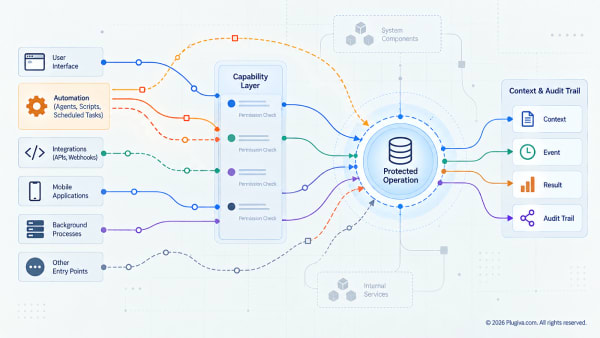
Once a project reaches this point, another kind of structure begins to make sense: something that can stand between intention and action, notice when an established boundary is being approached, and give the person making the change an opportunity to reconsider.
Architecture has expressed what the project has learned. Now the project needs a way to protect it.
Growing systems begin protecting what they have learned
Once a system has accumulated enough understanding, protecting that understanding becomes part of maintaining the system itself.
The protection does not have to begin as something formal. It may start with a habit, a review, a boundary that people agree not to cross, or a deliberate way of handling changes. What matters is the intention behind it: the project is no longer relying entirely on people to remember what experience has already taught them.
This is a subtle change in how we think about systems.
Earlier, structure helped us understand where responsibilities belonged. Governance helped preserve decisions and clarify how the work should continue. Architecture allowed some of that understanding to become visible in the system. Now another layer begins to appear: the system can help protect those decisions when the next change arrives.
That protection is valuable precisely because the people working on a project are not standing still. New requirements appear, priorities shift, circumstances change, and familiar work eventually becomes unfamiliar again. The original understanding remains useful, but the conditions around it keep moving.
A mature system does not assume that this movement will stop.
Instead, it gradually develops ways to make important boundaries harder to cross accidentally and important decisions harder to lose silently. Sometimes the protection is visible to the person making a change. Sometimes it works quietly in the background. In either case, its purpose is not to prevent change.
It is to prevent unintended change from becoming the new reality.
That distinction matters.
A healthy system should still be able to evolve. The goal is not to preserve every decision forever simply because it was made once. Some decisions will become outdated and should be changed. The purpose of protection is to make those changes deliberate rather than accidental.
This is why I no longer think of guardrails as restrictions in the narrow sense.
A good guardrail gives the person working with a system enough confidence to move forward without constantly wondering whether an ordinary action might quietly undermine something important. It creates a moment of awareness where memory alone might not be enough.
That matters whether the system is being managed by a large team or by one person.
A team may rely on reviews, established boundaries, issue tracking, or controlled access. A solo builder may rely on architectural conventions, backups, checks, or other forms of protection. The mechanisms differ because the circumstances differ, but the underlying need is remarkably similar.
The system has learned something through experience. And now it has a reason to protect that learning.
Perhaps this is where growth becomes most interesting. A system does not become mature simply because it contains more things. It becomes mature when more of what its builders have learned begins to survive independently of the moment in which it was learned.
What began as experience gradually becomes understanding. Understanding shapes responsibilities and workflows. It gains continuity through governance, takes form through architecture, and eventually gains protection through guardrails.
The system is no longer merely carrying the work. It is beginning to carry some of the lessons behind the work.
Where growth eventually leads
Looking at a growing website from the outside, it is easy to see only what has been added. More capability, more content, more decisions, and more ways for people to interact with it can make growth appear to be a story of accumulation.
But from within the project, growth looks different.
The internal changes do not arrive as a single transformation. A small project does not need to begin with the structure of a large one. Much of that structure emerges because the project encounters situations that make its previous simplicity insufficient, and each experience leaves behind something the system eventually needs to carry forward.
That may be the most important thing I have learned from watching projects grow.
Maturity is not the absence of complexity. It is the ability to give complexity a form that can still be understood.
A growing website therefore becomes more than a collection of features. It gradually becomes a system that carries not only the work its builders need to perform, but also some of the understanding they have accumulated while performing it.
The people remain essential. Experience still begins with them. Judgment still belongs to them. Some principles will always live in their minds before they find a place in the system.
But the longer a project survives, the less reasonable it becomes to expect people to carry everything alone.
The website has grown.
But more importantly, it has reorganized itself around what its builders have learned.
And perhaps that is what meaningful growth looks like from the inside.